
A Chronicle of Foundation
Being an Account of the Origin, Sovereignty, and Restoration of the Royal House of Navassa
Proclaimed and set forth for the instruction of the Kingdom's subjects, the edification of its friends, and the record of posterity.
What follows is not the history of a territory. It is the history of a people, a lineage, and a sovereign claim that endured — through revolution, exile, silence, and restoration — because it was carried in blood rather than inscribed on maps.
The Kingdom of Navassa does not measure its legitimacy in borders recognized by other states. It measures it in the unbroken chain of inheritance that connects its Sovereign to the revolutionary kings of Haiti, to a people who built something extraordinary in defiance of the world's expectations, and to a tradition that refused, across two centuries, to be forgotten.
This is that chain. This is that story.
The Island That Bore No Name
In the year 1504, Christopher Columbus, driven by storm and circumstance, came upon a small and desolate island lying in the waters between Hispaniola and Jamaica. His men found there neither shelter nor fresh water, and so named it Navaza — the barren one — and turned their ships away. For generations thereafter, the island was passed over and forgotten, a place defined by its emptiness, circled by the sea but claimed by none. Yet Providence is not without irony. The very barrenness that made Navassa invisible to passing empires would, in time, preserve it for a destiny more extraordinary than those empires could have imagined. While the great powers quarrelled over the fertile plains of Saint-Domingue and the sugar-rich islands of the Caribbean, Navassa lay in quiet waiting, neither colonised, nor contested, nor despoiled.
With the signing of the Treaty of Ryswick in 1697, the island passed formally into French dominion, subsumed within the territory of Saint-Domingue. It remained thus administered but unremarkable, until the fire of revolution transformed the world around it forever.
The Gift of a Revolutionary King
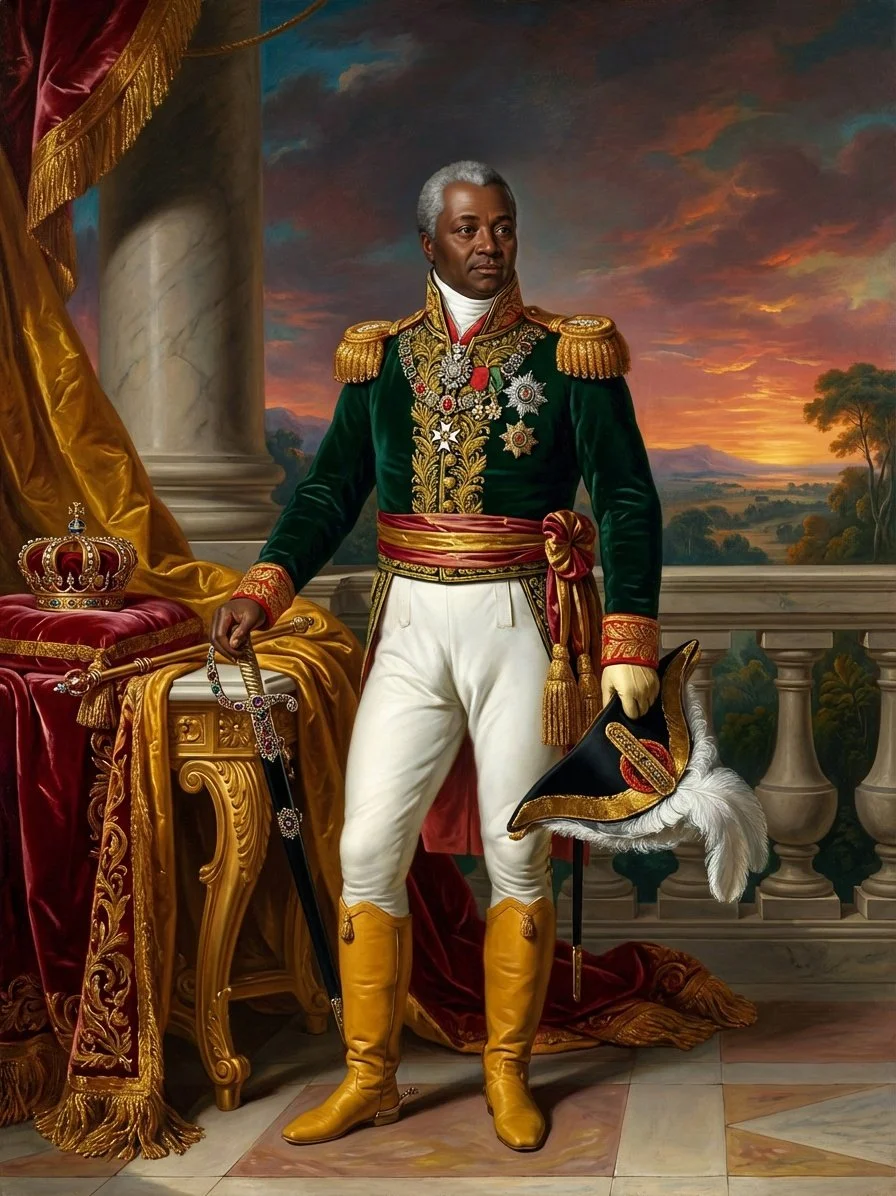
Henri Christophe, later King Henri I of Haiti.
On the first day of January, 1804, the people of Saint-Domingue proclaimed themselves free. The new nation took the ancient Taíno name of the island it occupied: Haïti. Its revolutionary hero, Jean-Jacques Dessalines, became its first head of state, and in the year following his coronation as Emperor Jean-Jacques I, he bestowed upon his most formidable general a title that joined that general's name forever to the island of the barren sea.
Henry Christophe was granted the title of Duc de la Navasse. The precise significance Dessalines attached to that gift is lost to the turbulence of the age that followed. But gifts of title are rarely without meaning. In the lexicon of the new Haïtian Empire, to be named for a place was to be entrusted with it and become its protector, its embodiment, its legitimate lord.
When Dessalines fell to assassins in 1806, the empire shattered. Christophe moved north, establishing a separate and sovereign state in the upper portion of Haïti. In 1811, he was crowned King Henry I, and from his palace of Sans-Souci — a name of magnificent defiance — he built a court that rivalled the thrones of Europe. He established a cabinet, a nobility, a code of law, and a vision of Haïtian majesty that would endure long after his reign had ended.
In his royal proclamations, Henry I declared himself sovereign not of the northern territory alone, but of Tortuga, Gonâve, and all other adjacent islands, including, explicitly, Navassa. The title he had received from Dessalines as a duke, he now claimed in his own right as a king. Navassa was no longer merely a name attached to a man. It was a realm.
A Line Unbroken
The reign of Henry I ended in tragedy. A stroke in the summer of 1820, combined with growing unrest stirred by agents of the republican south, brought his kingdom to the edge of collapse. On the eighth of October, 1820, rather than yield himself to his enemies, Henry I took his own life at the Citadelle Laferrière — the great fortress he had built to hold Haïti against any foreign power who might seek to undo her liberation.
His son, Prince Royal Victor-Henry, was briefly recognised as King Henry II, but was murdered by insurgents ten days after his father's death. The Queen, Marie-Louise, and her daughters fled into European exile, where the royal line of Christophe appeared to have reached its end.
But the line endured: through a daughter not of the queen, but of the king. Henry I had recognised and legitimised a daughter, Her Serene Highness Princess Blésine Georges Christophe, who in 1819 married Lieutenant General Jean-Jacques Alexis, Duke of Morin. Through this union, the blood and the legacy of King Henry I passed forward into a new generation.
Their son, Pierre-Henri Nord Alexis, was born in Cap-Henry on the second of August, 1820, only weeks before his grandfather's kingdom fell. While Queen Marie-Louise and her daughters went into exile, Pierre’s parents did not. Indeed, he navigated the turbulent politics of a republic that had not yet relinquished its dreams of its royal past. His path was neither straight nor easy: rivals displaced him, emperors exiled and restored him, and the dynastic claims he carried made him both an asset to those who wished to invoke legitimacy and a threat to those who feared it.
It was Emperor Faustin I who made the most consequential act of recognition. Restoring to Pierre his lands, his rank as prince, and the full constellation of titles he had inherited — Duke of Morin, Duke of l'Avancé, Count of Mirebalais, Count of Grande-Rivière, Duke of Port-Margot — Faustin I affirmed that the Christophe succession was not merely a family memory but a living dynastic reality, acknowledged by the imperial state of Haïti.
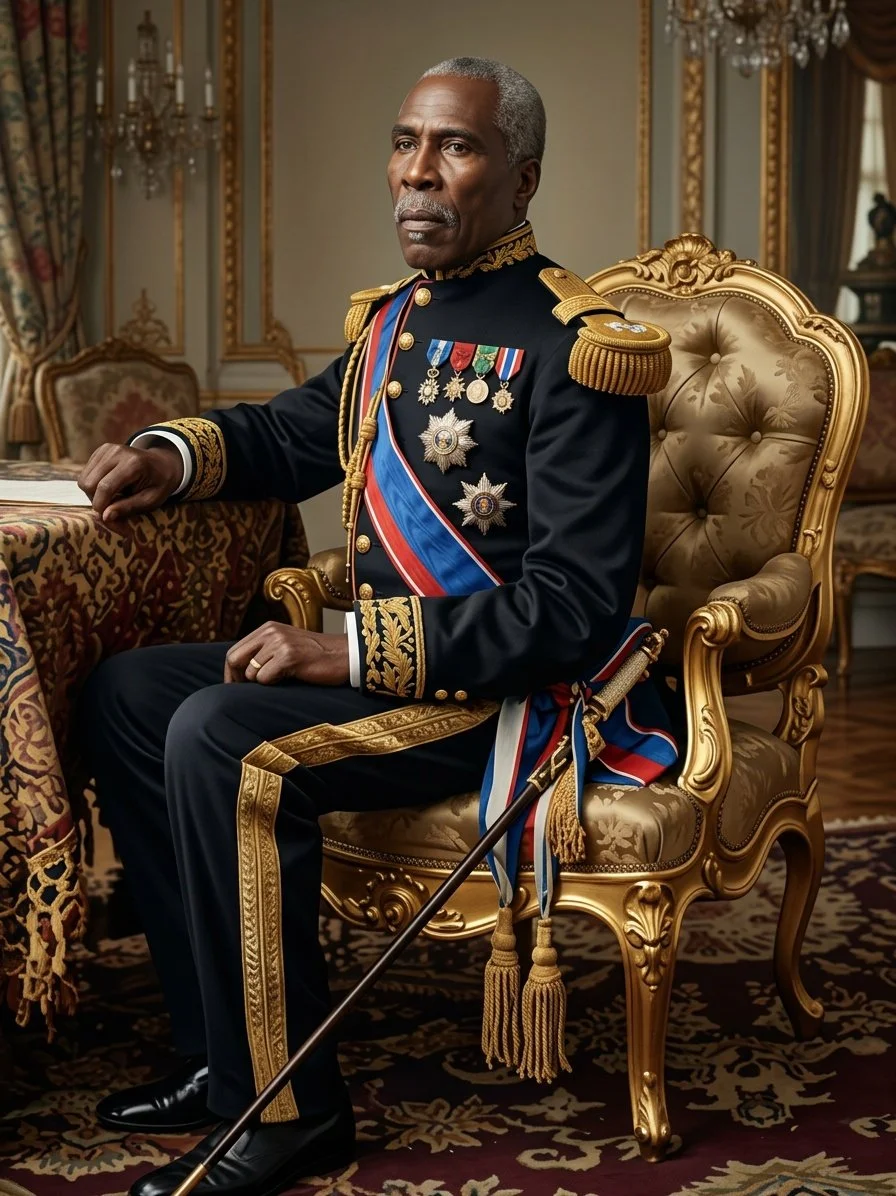
Pierre Nord Alexis, King of Navassa
Pierre Nord Alexis rose, in December of 1902, to the presidency of the Republic of Haïti, elected by the National Assembly for a term of seven years. He was eighty-two years old. His presidency was marked by an iron commitment to public integrity: he prosecuted a sweeping consolidation fraud that had plundered the Haïtian treasury, winning convictions against powerful men at home and abroad despite enormous pressure to relent. He oversaw public works, laid the cornerstone of the monumental Cathedral of Port-au-Prince, and drove forward the construction of the railroad at Cap-Haïtien at the government's own expense.
But Pierre Nord Alexis did not forget what his blood demanded of him. In January of 1908, then eighty-eight years of age, he began drafting a constitutional reform to establish hereditary succession to transform the republic, at last, into the kingdom it had always been in the memory of his family. The proposal unified his opponents and sparked a revolt he could not suppress. Economic crisis and famine followed. On the second of December, 1908, he was driven from power and fled into exile in Jamaica, where he died in 1910.
He had never sat upon the throne of which he dreamed. But in exile, his servants and courtiers addressed him as Roi — King — of Navassa. He was a monarch in spirit if not in circumstance, and the title passed with him into the long sleep of abeyance.
One Hundred and Seven Years
For one hundred and seven years, the Kingdom of Navassa lay dormant. Regimes rose and fell. The great wars of the twentieth century remade the map of the world. The island itself passed in and out of hands, its guano long exhausted, its shores left to seabirds and silence. The dynastic claim persisted only in memory and in the stories that descended, generation by generation, through the family of Henry I's legitimised daughter.
A dormant claim is not an extinct one. In the philosophy of royal succession, abeyance preserves rather than extinguishes. The title waited. The island waited. The sea, as it always has, kept its own counsel.
The Restoration
On the thirteenth of September, 2017, Marie-Adélina — a direct descendant of the royal line of Henry I, through the unbroken succession of the Princes de la Navasse — assumed the title and the throne of the Kingdom of Navassa. The long abeyance was ended. The dream that Pierre Nord Alexis had carried into exile was, at last, fulfilled.

Marie-Adélina, Queen of Navassa
The Kingdom of Navassa does not require the recognition of other states to know what it is. Its legitimacy is older than most flags. It descends from a revolutionary king who built a palace and called it Sans-Souci because he feared nothing that power could threaten when justice and sovereignty were on his side. It descends from a general who was given a title for a barren island and made of that title something noble. It descends from a president who chose exile over abandonment of principle.
The island the sailors once named for its emptiness is empty no longer. It is filled with the weight of history, the continuity of blood, and the intention of a kingdom that takes seriously both its inheritance and vocation.
That looks upon the sea not merely as a boundary, but as the domain entrusted to its care.
So it has been. So it shall remain.
The history recounted here is not merely a record of the past. It is the constitutional ground on which the Kingdom of Navassa stands today.
Navassa's sovereignty is not territorial; it does not rise or fall with the possession of land. It is not conditional; it does not depend on the recognition of foreign powers. It is dynastic and cultural: rooted in the lineage of Henry I, carried forward through generations, and now embodied in the reign of Marie-Adélina. Where the sovereign is, the kingdom is. Where the people gather under this Crown, the kingdom endures.
This is what it means to be a sovereign cultural movement organized in monarchical form. Not a simulation of statehood. Not a claim awaiting approval. A living inheritance, restored and continuing — for those who carry this heritage, and for those who choose to join themselves to it.