
The Lady of the Seas
Dame des Mers · Domina Maris
A scholarly account of Navassa's most ancient spiritual presence, her names, and her enduring sovereignty over the waters of the kingdom.
Origins & Mythology
The Lady Before All Names
Among the peoples of Navassa, there exists a presence that precedes the kingdom itself — precedes, many would argue, any human institution whatsoever. She is called the Lady of the Seas. She has no founding myth in the conventional sense, no moment of creation assigned to her, no origin story in which she comes into being. She simply is, as the ocean is: antecedent to memory, indifferent to dynasty, older than the names by which she is addressed.
The mythology that has accrued around her over centuries does not tell of her birth but of her arrivals — her manifestations at particular moments in history, her interventions in the lives of sailors and the fates of kingdoms. She is said to have appeared to the first settlers of these islands as a figure of tremendous stillness rising from the water at dusk, crowned, luminous, and wordless. She required nothing. She simply made herself known.
“She did not speak. She did not need to. The sea spoke for her, and those first men and women understood, in the way one understands thunder, that something sovereign had received them.”
In the oldest oral traditions, the Lady is depicted as a being of dual nature: serene and annihilating, generative and consuming, the force that fills the nets of fishermen and the same force that swallows ships whole. She does not favour her devotees over the indifferent sea — she is the sea, in all its moral complexity. To venerate her is not to expect protection but to enter into honest relationship with the nature of things.
Her domain is described in devotional tradition as threefold: the surface waters where ships sail and storms break, the deep waters where light does not reach and ancient things move, and the waters beneath the world — the currents that connect all seas to one another, the invisible rivers that run beneath the ocean floor. This last domain is considered the most sacred, for it is said that whatever enters the sea eventually reaches her, carried inward by those invisible currents toward some unfathomable centre.
It is in this mythological register — as sovereign of all waters, receiver of all that the sea takes — that the Lady of the Seas is most distinctly herself, prior to and independent of any theological tradition that has since claimed, adapted, or illuminated her.
Her Many Names
One Presence, Many Faces
The Lady of the Seas is known by many names across Navassian religious life, and it is a point of broad consensus — though not of doctrinal enforcement — that these names refer not to distinct beings but to facets of a single, irreducible presence. Each name carries its own tradition, its own iconography, its own community of devotees, and its own history of arrival in the Caribbean world. Together they constitute a portrait that no single name alone could capture.
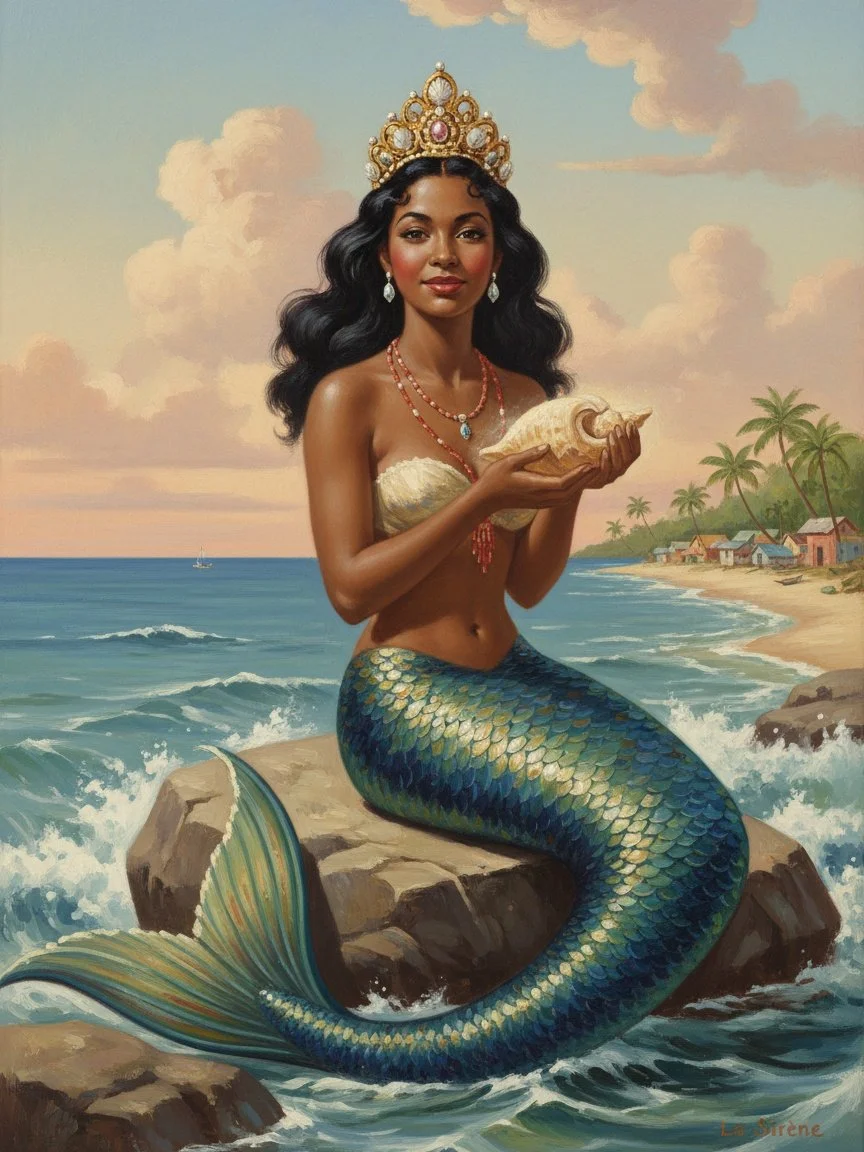
La Sirène (Haitian Vodou tradition)
The mermaid queen, consort of Agwé, sovereign of the ocean depths. La Sirène is the most immediate and intimate of the Lady's faces in Navassa — the one most present in fishing villages, in healing rites, in the dreams of those whom the sea has touched. She is depicted as a great crowned mermaid of extraordinary beauty, and her devotees describe her as demanding and generous in equal measure. She may draw the devoted down into her underwater palace, where they learn secrets of the deep, or she may release them back to the world transformed and gifted with second sight.
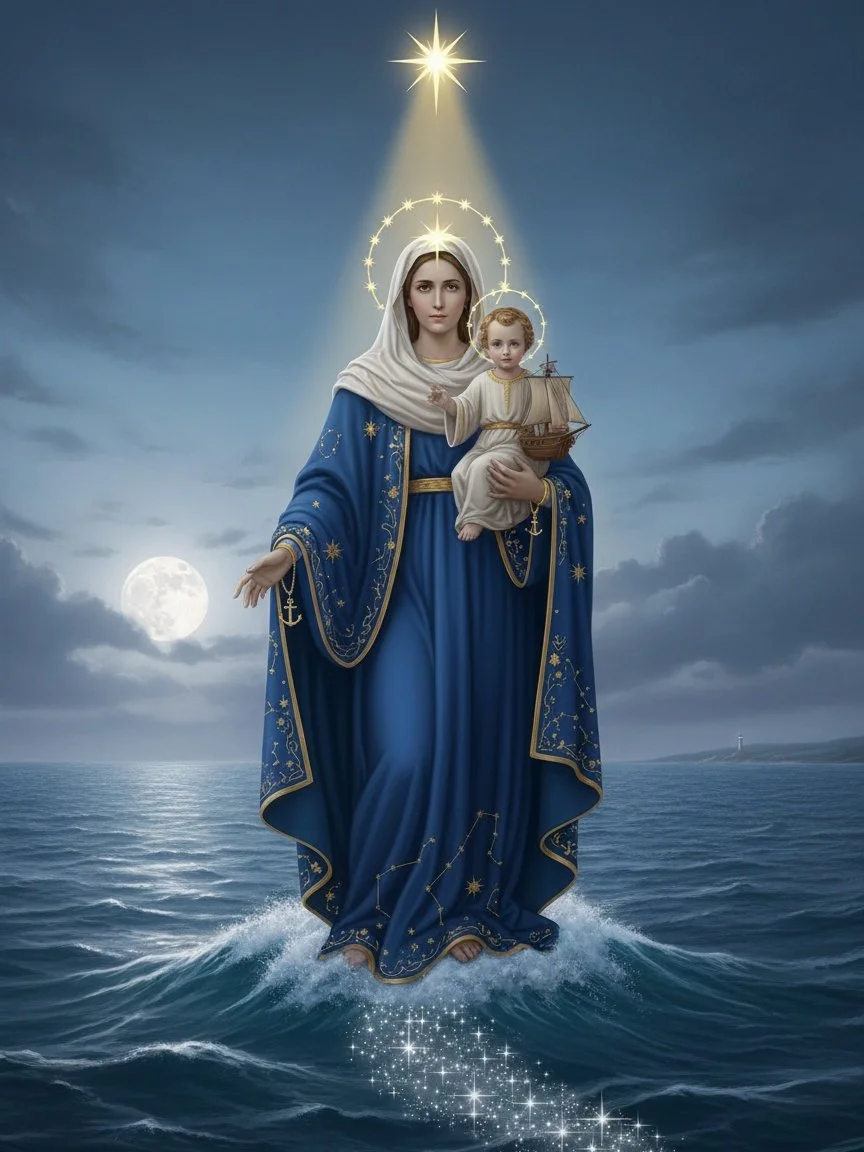
Stella Maris (Catholic maritime tradition)
Star of the Sea, the name by which Catholic sailors across the centuries have addressed the Virgin Mary as their protectress upon the waters. In Navassian chapel tradition, Stella Maris occupies the space where Christianity and devotion to the Lady converge. Her image — a crowned woman bearing a star, sometimes holding an anchor — hangs in the churches of coastal settlements. The faithful who address her in Catholic terms are not considered by their neighbours to be worshipping a different being, merely arriving at the same presence by a different road.
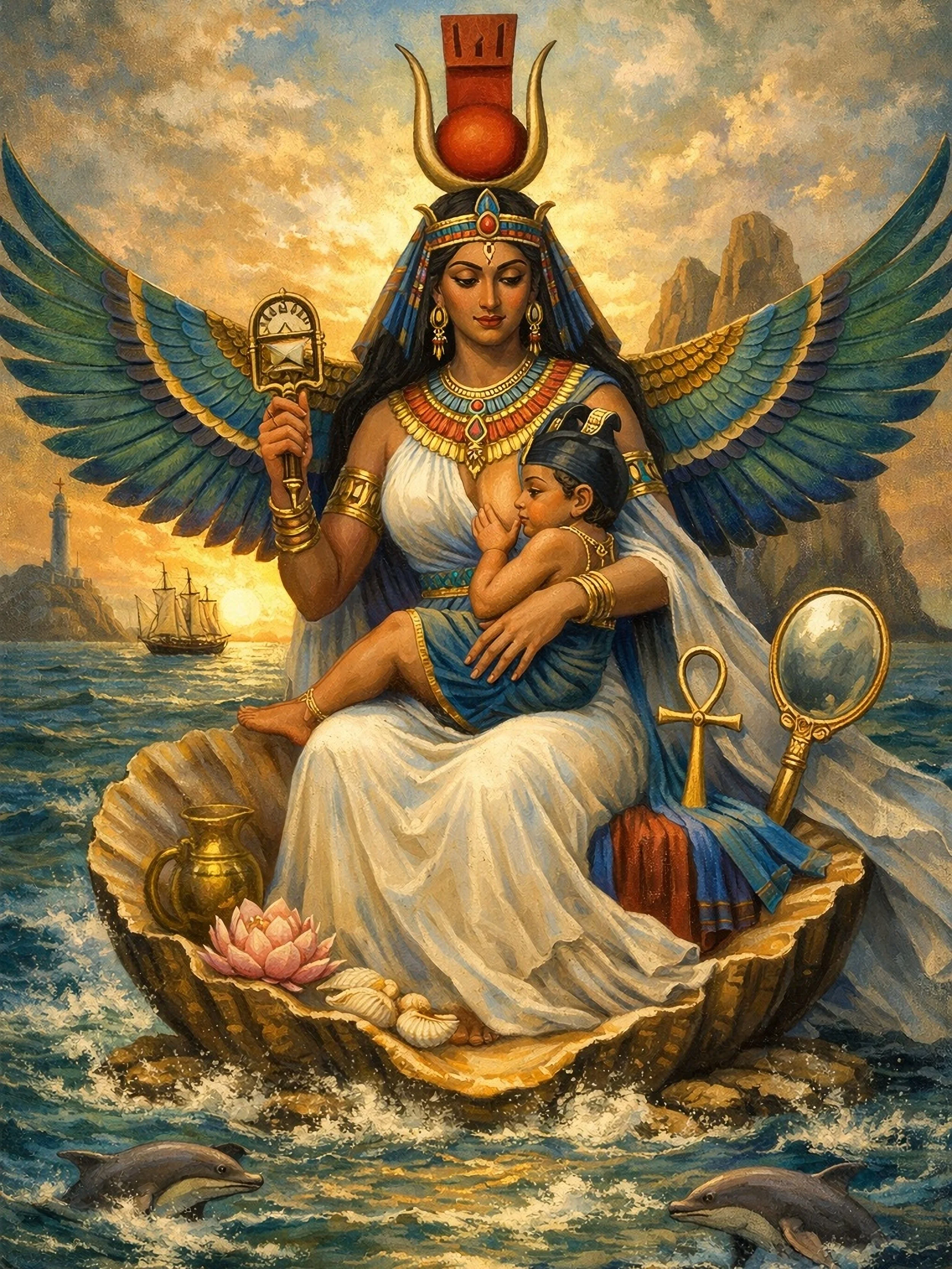
Isis (Ancient Egyptian & Mediterranean tradition)
Among those of the mystical and scholarly traditions, the Lady of the Seas is understood as Isis herself — not merely her maritime aspect, but the goddess in her totality: mother of all things, sovereign magician, mourner and restorer of the dead, she who gathered the scattered pieces of Osiris and breathed life back into what had been destroyed. Her aspect known as Isis Pelagia — Isis of the Sea — is understood as the face she turns toward the waters, the particular door through which she makes herself known in Navassa. To worship the Lady in this tradition is not to worship a sea goddess but a goddess of everything, encountered here through the sea. Her iconography in this tradition extends beyond the crown and mirror: the throne hieroglyph upon her head, the sistrum, the wide wings spread in protection, the nursing of the divine child. She who reassembled what the world had broken apart.
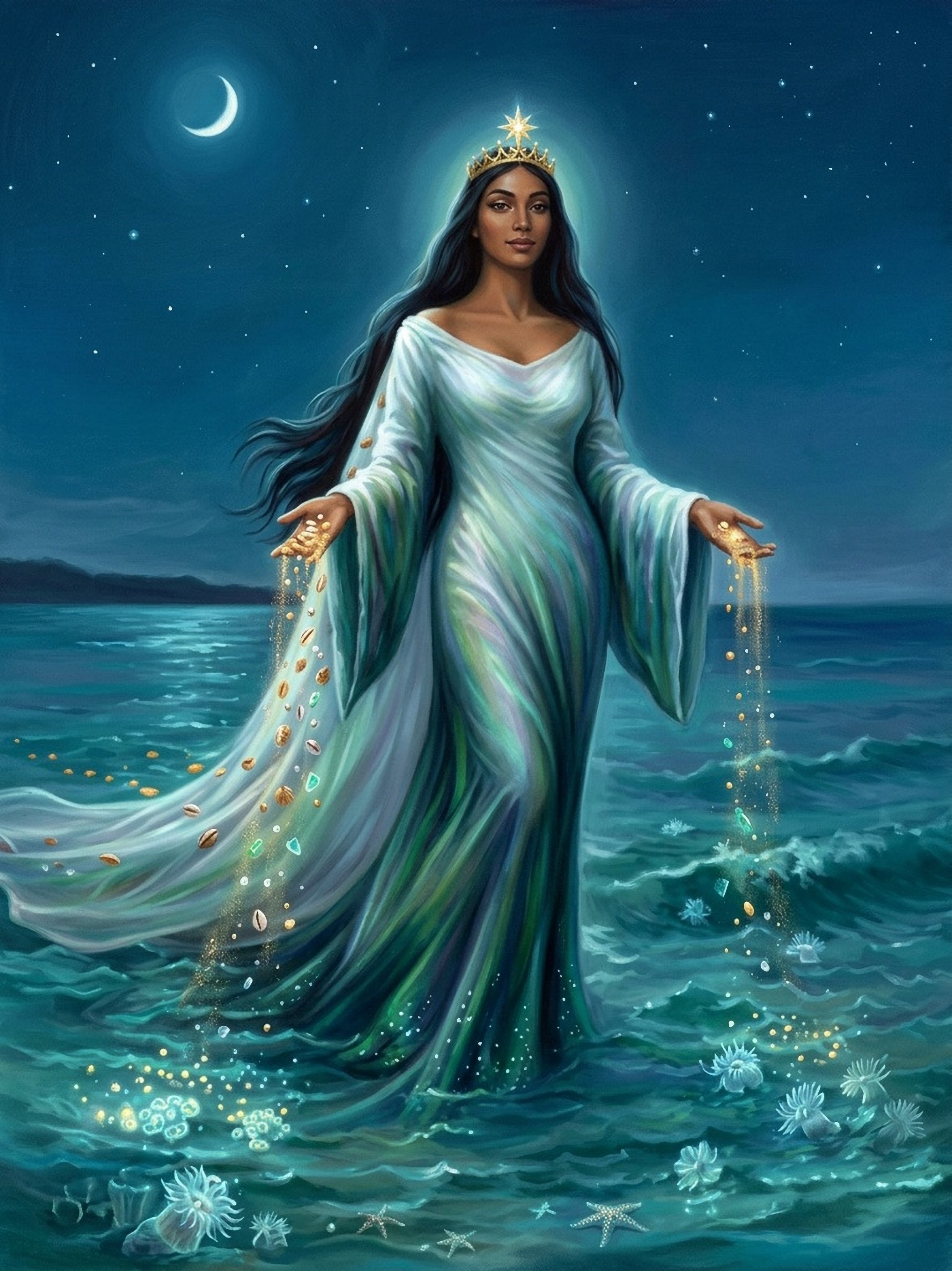
Notre-Dame des Mers (Navassian vernacular tradition)
Our Lady of the Seas— the informal vernacular name by which many Navassians address her in everyday speech, particularly those who hold no strong affiliation with any specific tradition. It is at once the most ecumenical of her names and the most distinctly local: a French-language title that belongs neither to formal Catholic liturgy of the Virgin Mary nor to Vodou ceremony of La Sirène nor to those who praise the hymns of Isis, but to the lived devotional life of an island people who have made her their own.
It bears noting that devotees rarely move between these names casually or interchangeably. A woman who has kept a shrine to La Sirène since girlhood does not typically address her as Isis. The names belong to their traditions and their communities. What is understood — implicitly, without requiring articulation — is that the being encountered at the water's edge is the same, whatever one calls her when one calls out. And for those in the Isiac tradition, that understanding carries a particular weight: the sea is not her boundary but her threshold. She is larger than any ocean.
The Scholarly Debate
On Her Origins: The Question That Remains Open
No question in Navassian scholarship has generated more sustained and passionate debate than this one: is the Lady of the Seas, in her Caribbean manifestation, a continuation of the worship of Isis herself — carried westward through Africa and across the Atlantic — or did she arise independently, as a convergent spiritual form produced by the shared human experience of the sea?
Those who argue for continuity — often called the Isiac school — advance a claim that is deliberately grand in its scope. The religion of Isis was, in antiquity, among the most widely distributed in the known world: from Egypt to Rome, from Roman Britain to the shores of the Black Sea, her temples stood and her mysteries were practised. Crucially, her cult penetrated deeply into North Africa — into Numidia, Carthage, and the Saharan trade networks — where it encountered and intertwined with indigenous spiritual traditions over centuries. The Isiac school argues that elements of this devotion did not simply vanish with the Christianisation of the Mediterranean world but survived, absorbed into African spiritual traditions that would eventually travel across the Middle Passage. In this reading, La Sirène is not a coincidental parallel to Isis but a living descendant — the goddess herself, arrived in the Caribbean under a new name, wearing a new face, speaking a new language, but possessed of the same sovereign depth. They point to shared iconographic and theological structures: the crown, the mirror of self-knowledge, the dominion over water, the resurrection current — for Isis, who restored the dead Osiris, carries always the promise that what has been destroyed may be gathered and made whole again.
“We are not speaking of a minor maritime cult that happened to cross an ocean. We are speaking of one of the ancient world’s most enduring and capacious religions, which spread along every trade and conquest route the Mediterranean knew, which entered Africa at its roots, and which the Middle Passage could not kill — because she has always been the goddess who defeats death. La Sirène did not arrive from nowhere. She arrived from Egypt, by way of Dahomey, by way of the sea.”
The opposing view — held by those of the convergence school — does not deny the power of the parallels but resists the historical claim. Every maritime culture, they observe, has produced a sovereign goddess of the sea. The crowned, beautiful, death-adjacent figure of the deep waters appears in Greek, Roman, Norse, Polynesian, West African, and Caribbean traditions alike. The similarities between Isis and La Sirène are real, but they reflect a shared archetype — the universal human response to the ocean's combination of abundance and annihilation — rather than historical transmission. To claim a direct lineage, in the absence of documentary evidence, is to impose an Egyptian framework on an African-Caribbean tradition whose integrity and originality deserve to stand on their own terms. La Sirène, in this view, does not need an ancient ancestor to be venerable. She is venerable because of what she is and what she has meant to the people who have kept faith with her across centuries of suffering and survival.
“La Sirène arose from the Atlantic, from the experience of the Middle Passage, from the grief and endurance of a people who found in the sea both their torment and their continuity. She does not require Isis as a credential. To insist she must be traced to Alexandria — however romantically intended — risks becoming its own form of erasure: the subordination of a living African-Caribbean tradition to a Mediterranean genealogy that was not asked for and may not be wanted.”
A third position, increasingly influential among younger Navassian scholars, holds that the debate may rest on a false premise. Perhaps the question is not whether the worship of Isis reached the Caribbean but whether origins determine meaning. The Lady of the Seas is what she is in the lives of those who venerate her — and she is, to all of them, something that exceeds any single history. She may be ancient beyond tracing, her roots reaching simultaneously into the temples of Alexandria and the sacred groves of Dahomey, into the ocean floor and the sky above it. The Isiac and convergence accounts need not be mutually exclusive: Isis may indeed have traveled westward, and La Sirène may indeed have arisen from the Atlantic, and both may be true because they are accounts of the same being from different angles of approach. The search for a single origin, in this view, is a category error — applied to a presence who has always been larger than any single history.
Relevance & Impact
The Lady in Navassian Life & Statecraft
The Lady of the Seas is not merely a figure of private devotion or academic dispute. Her presence permeates Navassian public life in ways that, while never officially mandated, are nonetheless real and consequential. She is, in a meaningful sense, the kingdom's oldest and most continuously present symbol — antedating the monarchy, the constitution, and the flag.
Her influence is visible in the material culture of the kingdom: in the blue cloth hung in doorways during storms, in the anchor-and-star motifs that appear on everything from official stationery to fishing vessels, in the vernacular architecture of coastal shrines that no municipal authority has ever seen fit to regulate or remove. She is present in the names Navassians give their daughters, in the toasts made at weddings and the prayers spoken at funerals, in the particular quality of attentiveness with which islanders regard the sea.
She is present, too, in the language of Navassian statecraft — not in any official or liturgical capacity, but in the symbolic vocabulary the kingdom has chosen to represent itself to the world. The monarchy has consistently drawn on her imagery to communicate the kingdom's character: its maritime identity, its depth of spiritual inheritance, a crowned mermaid figure in its coat of arms, and its claim to a sovereignty that is not merely political but rooted in something older and more elemental.
The kingdom's highest order of chivalry takes the Lady of the Seas as its patron and its governing symbol. The Order does not require of its members any particular religious affiliation or theological position regarding the Lady's origins and nature. What it does require — and what it honours — is a quality of devotion to Navassa's maritime heritage and to the values the Lady represents: wisdom, sovereignty, depth of character, and the particular courage demanded by lives lived close to the sea.
Perhaps most significantly, the Lady of the Seas represents something rare in the life of a young kingdom: a point of genuine cultural continuity. Navassa was constituted from peoples of diverse origins, inheriting traditions from Africa, Europe, and the indigenous Caribbean world. The Lady predates all of these inheritances and belongs, in different ways, to all of them. She is one of the few figures around whom Navassians of very different backgrounds find that they are, without having negotiated it, speaking of the same thing.
In this sense, whatever one believes about her nature or her origins, the Lady of the Seas performs a function that no institution has managed to replicate: she holds the kingdom together at a depth below politics, below law, below the ordinary mechanisms of social cohesion. She is what Navassa remembers when it remembers itself.
“We do not all agree about who she is. We do not need to. We agree that she is there, in the water, as she has always been. That is enough.”